
Kimberly Cameron
TOMás downey, DiviNG BOARD.
picton, on: invisible publishing, 2025. $24.95
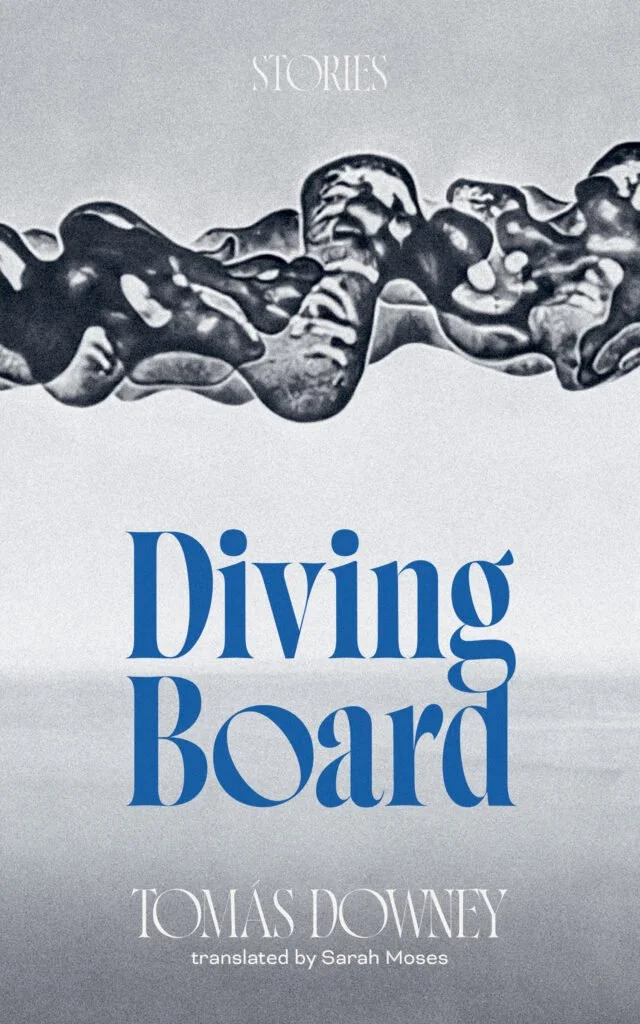
Dissecting human nature through an absurdist lens, Diving Board is an addictive anthology of quiet apocalypses in the form of short fiction. Tomás Downey’s new collection of nineteen stories contains a delicious array of ecological horrors and surrealist afflictions that will amuse in their confrontation with, and thrilling embrace of, the unknown.
Readers are gently ushered into the first of Downey’s strange worlds with the opening story, “The Cloud.” The piece begins in a manner reminiscent of Stephen King’s The Mist, with a heavy fog descending upon an unsuspecting suburban neighbourhood. Unlike King’s mist however, which disguises various grotesque creatures, the horror of Downey’s fog is in its unnervingly quiet and insidious subtlety:
The air was stagnant and sticky. Every room in the house was impregnated with a pungent smell, like wet cardboard. The walls and floors began to sweat and were soon covered in tiny drops. Then the furniture swelled and slugs appeared, feeding on the moist wood.
Brilliantly conveyed from the original Spanish by translator Sarah Moses, Downey’s language is textured, indulging in the tactile details of a slowly rotting household. Though the images of decomposition feed into the story’s tone, the true horror of “The Cloud” is derived from the unnerving calm of its focal family, who passively ease into their new reality. This is not a story of resistance or escape, but of submission to circumstance as they endure the snails, the fungal-coated throats, and the rain that now marks the passage of their days.
“The Cloud” is perfectly complemented by the later story “The Täkis,” where Downey cheekily plays with the trope of the alien invasion—but makes his extraterrestrials gentle, huggable performers: “They were big and fluffy, like teddy bears, with huge, round eyes and fur in bright colours. They danced as they walked and waved at people exaggeratedly.” These are hardly the fear-inducing, civilization-threatening aliens we might expect in fiction, which is perhaps the point. “The Täkis” is told from the removed perspective of an observing couple; they watch as the city slowly empties, people abandon their cars, and load into a silver spacecraft. While the global abduction unfolds, the couple’s push-and-pull dynamic becomes the story’s primary conflict, with Malena grounded in her vehement skepticism, and the narrator struggling to suppress their compulsive urge to join in on the mass frenzy. In this way the story becomes an exploration of their relationship, and of the tension between our competing impulses for collectivity and individuality.
Alongside thematic threads of autonomy and isolation that run through the collection, the stories of Diving Board are equally imbued with the imagery of equilibrium and relational space—of characters try ing to find or maintain balance. This visual first appears in “Astronaut” where the narrator is no longer confined by gravity. Pressed against the ceiling, the unanticipated change of their reality slowly begins to erode their sense of self, and they are only released from this existential state by their wife’s embrace: “She raised her legs and locked them behind my back, which had come away from the ceiling. We floated there, mid air, our weight balanced.” Often taking on anomalous forms, Diving Board’s exploration of equilibrium is woven into each story’s particular manifestation of grief. The brief moment of balance in “Astronaut” harkens both the loss of a relationship, and the identity that was forged by the routine it created. Another example can be found in the titular story “Diving Board,” where a child, Josefina, disappears into thin air when she plunges from the community pool’s diving board. The build up to this disaster begins from the story’s first page, as her father is plagued with a knowing but unknown dread that plays on the ever present parental fear of losing a child. Still, the fallout manages to leave him, and us, in panicked disbelief—an effect attributable to Downey’s artful storytelling.
Though the stories in Diving Board are inhabited by their share of monsters, be they teddy bear aliens or idle and absent children, the terror is rarely depicted as such in the beginning. Downey’s gift for psychological horror is on full display in one of the most evocative stories in this collection—a ghost story without any ghosts at all. “The Men Go to War” follows Jose, locked in some hellish paradox, as she endures the news of her husband’s death over again, every time receiving his same mahogany-handled knife—the only personal item salvaged from his possessions—delivered by the same visiting officers. After each visit, she adds the new knife to the growing collection of identical knives she’s already received. The story masterfully materializes grief and the disorienting, gravitational hold it exerts on those of us left behind, as Jose sits on the floor counting the knives, “realizes she’s crying, and loses count, begins again.”
Diving Board is a compelling collection of new horrors that indulge in the inexplicable and the unexplainable, and that proffer a satisfying selection of oddities for the courageous reader. They exert a consistent and delightful absurdity where horses can be cultivated from flowerpots and breakups can be communicated through drive-away taillights, but the dark fun of the stories is always complemented by the gut-wrenching introspection of, and reflection on, human nature.
KIMBERLY CAMERON
is a queer writer from Cambridge, Ontario, with a fondness for irrational characters and mundane absurdity. She is currently completing her final year of Sheridan College’s Honours Bachelor of Creative Writing & Publishing program. Her work can also be found in issues 4 and 5 of B222 Journal.