
J.M.
andrew forbes, field work: on baseball and making a living.
picton, on: assembly press, 2025. $23.95
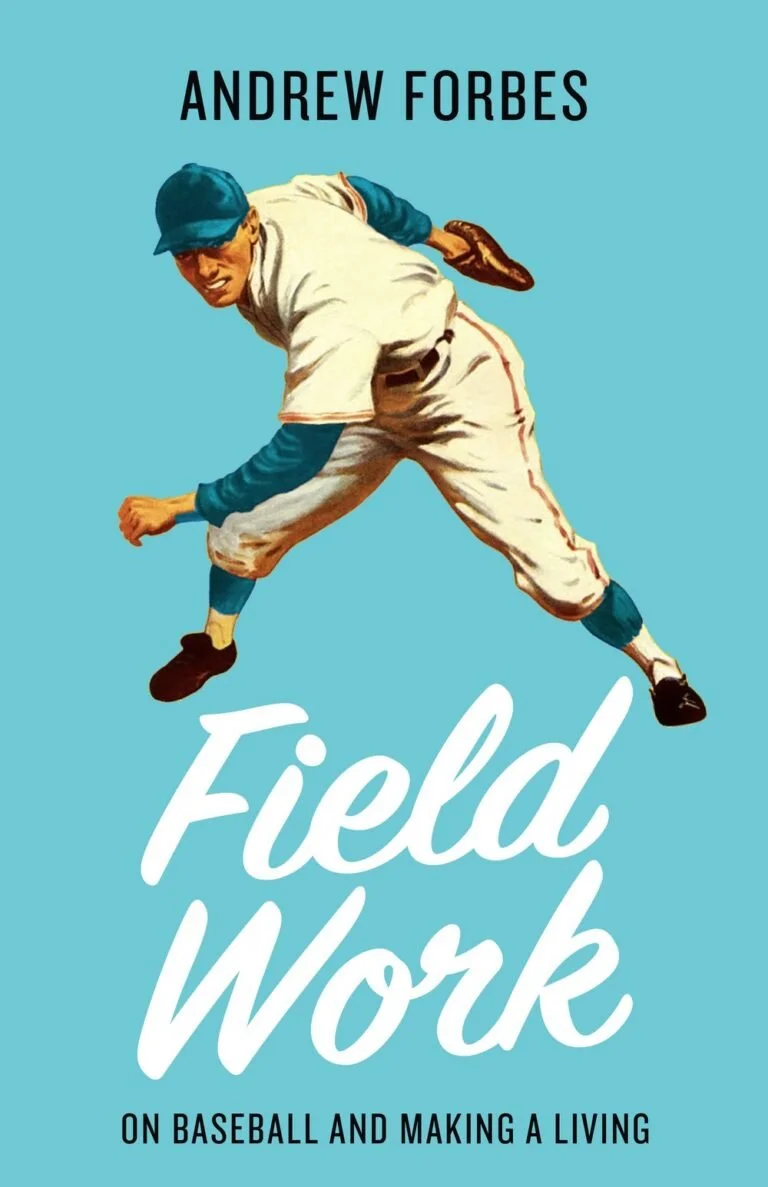
It’s fitting that a book about the relationship between work and baseball, from the rich, complex histories of the grounds on which the game is played, to the corporate monetization of the sport’s various means of production, begins with the origins of the Sporting News Player Contract Cards Collection. Sports dad and baseball writer Andrew Forbes describes this archive of historical index cards tracking the careers of more than 180,000 professional ball players simply as “a massive trove of information about a group of individuals spanning economic and social lines who shared a profession.” Across the span of the twenty short essays in Field Work, Forbes weaves fact, analysis, and association into an elegant discourse on how the lives of the players documented in these cards carved the game to what it is today, and how their work contributed to the evolution of the sport.
With only one remaining Major League Baseball team in his own country, Forbes’s observations on professional baseball often go beyond the Toronto Blue Jays here (though the team features prominently as a touchstone throughout the book). His travels south of the border take him to cities where he ponders the layers he sees underpinning the modern game—of demolished physical infrastructure bulldozed and rebuilt, and of the lives of the unsung heroes and lovable weirdos of the game at risk of being forgotten. The corners of the archive and the ballpark in which these traces of the past linger often lead Forbes to pull back the layers of the game itself, drawing a fresh chalk line between past and present. When he looks out the window of Chicago’s Art Institute at modern-day Millennium Park, he is reminded of the White Stockings ballpark that formerly stood there in the late 1800s. In Minnesota’s Twin Cities, as he watches a St. Paul Saints game, he is reminded of the baseball-loving Veeck family, whose marketing and promotion of various teams always operated with fun as the first priority (albeit some times to disastrous PR ends). Forbes explains that the spectacle-filled game-day experiences we see now came to be at ballparks “either be cause someone named Veeck invented them, or someone else did and a Veeck perfected it.” Forbes recognizes that, in all its forms, baseball is a game. But this game, he writes, can be a dream that’s always out of reach for some, a summer job that pays for a career outside of throwing and batting for others, and a pastime that connects players and fans to the earth itself. It is serious, and it is meaningful. So while he stands in one of these new, modernized ballparks buzzing with the “cultural riches” and dizzying spectacle wrought by increasingly corporate, profit- driven team ownerships, the author never fails to stop and remind him self, and us: “You know, there used to be a ballpark here.”
Forbes’s writing is direct and daring and it never shies away from delivering hard truths about the history of the game he loves. While studying several player index cards, Forbes comes across notable figures like Curt Flood, who fought against contract negotiations that treated players like objects up for trade instead of thinking, feeling human beings, and Hubert “Shucks” Pruett, who defied the “established model” of a professional ball player and used his baseball earnings to fund his career in medicine. The author also delves into the backstories of several Black players like Satchel Paige, whose legacy helped break down racial barriers in professional baseball. Connecting past to present, Forbes demonstrates how the underpaid work of these pioneers opened doors to today’s routinely multimillion-dollar contracts—wages and working conditions that now far exceed what is considered merely liveable.
There is an engaging and personal sentimentality to Forbes’s ruminations on the history of professional ballparks and players. He recounts his experience of becoming an assistant coach for his sons’ youth baseball team after years of chauffeuring his children to sports activities of various kinds; his wife Christine comments on her husband’s eventual adoption of the role with resignation: “It was only a matter of time.” Forbes interprets his wife’s comment as “meaning not that my vast experience and great expertise were at last being recognized with the invitation, but rather that within the network of care provided by kids’ sports, it’ll eventually be your turn to set up and volunteer for something.” In the titular chapter, “Field Work,” the author evokes the poetic and detailed preparation of a youth baseball field—from dirt to grass—with slowness and care. In observing the young players warming up on the field before first pitch, to the trampled grass where the coaches stand, he concludes that field work is what allows the game to exist: “Tending, planning, guiding. The games don’t happen if the field’s not ready. The lines need to be painted, somebody has to write out the lineup … It might as well be us.” While he describes his own contributions to the sport as a youth coach as “a small cog in the great machine” of the culture of baseball, the field work done by Field Work represents much more than this for the spirit of the game above and beyond the diamond; it celebrates the plethora of hidden history and work that has always supported the game at every level, and provides a space where baseball fans can pause for a moment to contemplate how the complex infrastructure of the sport is always somehow welcomingly human.
J.M.
is a fourth-year student in the Creative Writing and Publishing program at Sheridan College. Her favourite genres are creative non-fiction, historical fiction, sports fiction, and literary fiction. She has written several articles for the Sheridan Bruins, covering athletes and sporting events. She is also a volunteer for the 2026 TIAC as one of their community engagement coordinators.