
Selena Mercuri
Carrianne Leung, wonderland road
toronto: harpercollins canada, 2026. $24.99
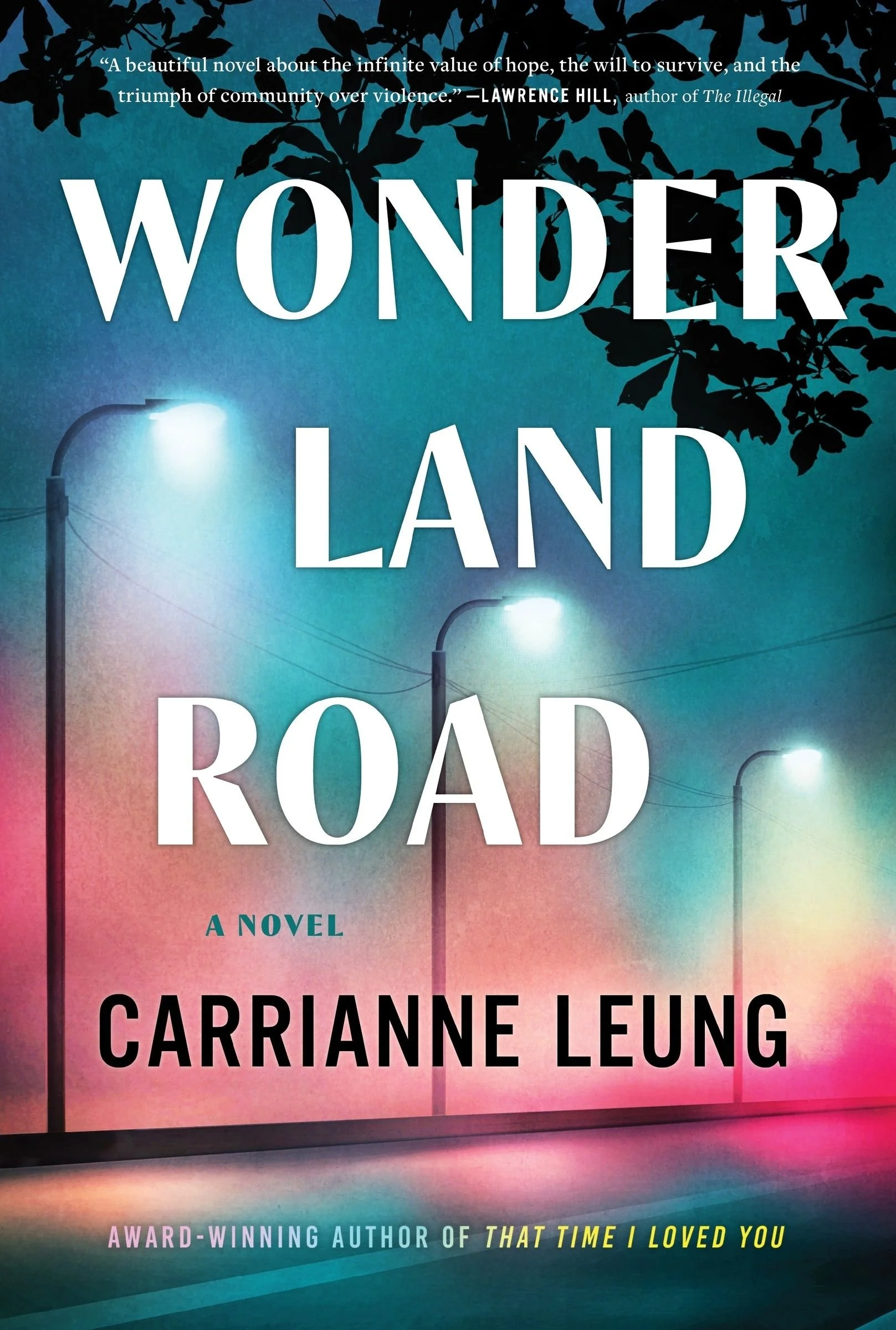
Wonderland Road is a novel populated by ghosts. In this post-apocalyptic tale, the boundary between the living and the dead is porous, as characters are both haunting and haunted. The ghosts here are literal and metaphorical: the spirits of ancestors, memories that arrive uninvited, and people who risk becoming ghosts themselves.
The novel centres on three characters—Pauline, Jing, and Julian— whose lives intersect in the suburban neighbourhood of Wonder, located outside of what was known as Toronto before the disintegration of society through food shortages, wildfires, and institutional collapse. In the before-times, Wonder was “filled with racialized people who couldn’t afford to live downtown but commuted to it every day to clean offices, sell fast food, work in construction.” Now the community there is hollowed out because most of the healthy adults have gone to work at Bayson Farms, a corporation that quickly grows to become “an enormous force, consolidating agribusiness and housing and pretty much whatever the government had allowed to be privatized.” The Bayson Farms employees from town used to visit and write letters, but now the visits and letters have mysteriously ceased. Left behind are mostly children and the elderly, trying to maintain their humanity in this new world.
Pauline, living in what was formerly Toronto (and estranged from her sister Mei for twenty years), receives a letter asking her to return to Wonder to care for Mei’s twelve-year-old daughter Jing while Mei works at the Farms. Pauline leaves the city, where conditions have grown increasingly unstable, to take on a role she feels unprepared for in the neighbourhood where she grew up—a neighbourhood to which she hasn’t returned since fleeing her abusive mother.
Jing, living in the Children’s House (where all the parentless children stay), hasn’t heard from her mother in months. She skips school to sit on a bench on Wonderland Road: “the bench was known as the Bench, but sometimes people called it Jing’s bench because I was always there. It was just an ordinary bench beside the bus stop on Wonderland Road, but the bus didn’t come anymore.” She waits there, thinking that the bench is the perfect place to stay until her mother returns, even if her mother—if she’s coming back at all—would likely be returning on foot. She counts to one hundred over and over, a ritual of hope in the face of maternal absence. It is in the thrall of this yearning that Jing sees ancestral ghosts. When Pauline confesses that Jing’s grandmother used to hit her and Mei, for example, Jing observes that “the ghosts jumped around, agitated. They went crazy mad in the living room as Pauline said what she said. They spun, leaped, tore their flesh out piece by piece.”
Pauline herself moves through the world in a kind of emotional paralysis. Jing describes her aunt as someone who “stopped looking for attention, who didn’t care to be understood. She had words, but she didn’t use them. Some of the quiet ghosts were like that, too. They faced the walls or sat in the corners making themselves as small as possible.” Her observations cut through adult evasions with startling clarity throughout the narrative, suggesting that the emotional life of this family, like the ghosts Jing senses around her, is defined as much by what is hidden or suppressed as by what is openly expressed.
The novel reveals one of Pauline’s deepest fears: becoming like her mother. “When Jing got rude, Pauline felt the urge to do something mean. Pauline’s mind let her see herself hitting the child across the head, as her mother would, and this terrified her.” The moment captures one of the novel’s most persistent tensions: the fear that the past is never quite finished with us. Pauline understands how easily the patterns she grew up with could reappear in the present, and her horror at the prospect suggests an awareness that breaking those patterns requires constant vigilance. Wonderland Road repeatedly asks whether awareness alone is enough to interrupt these cycles, or whether the past continues to shape the present in ways the characters cannot ever fully escape.
The storytelling captures Pauline’s inner life through the fragmented logic of memory; her recollections arrive in flashes she cannot control: “She didn’t invite them, but the memories came anyway. They were slivers of remembered faces, sparks of forgotten feelings. There was the gentlest stroke of her cheek from Ma when she had the measles [. . .]. Mei laughing until she was doubled over at a joke Pauline made. Her lover whispering that he loved her for the first and only time.” The effect is to immerse the reader in Pauline’s interior life, where the past surfaces hauntingly and unpredictably, and where emotional meaning accumulates through brief, vivid flashes.
Julian’s storyline provides a different perspective on loss and duty. His family stays to run the community while others leave for the Farms, and his brief, first experience of love with a guy named Len—an encounter that leads him to question his sexuality—is cut short by the collapse of civilization. He is filled with regret for hesitating when he had the chance to pursue things further with Len. By the time he works up the courage to text “len ily fr,” it is too late. The novel treats his questioning sexuality with tenderness, acknowledging that even as the world falls apart, the human heart continues its work of discovering itself.
Julian’s regret also reflects one of the book’s recurring preoccupations: the fragile timing of human connection. Moments of vulnerability, self-recognition, and love arrive slowly, often after hesitation, but the world does not always wait. In reading Wonderland Road, it becomes clear that personal awakenings and emotional risks remain deeply human concerns even amid catastrophe, and that what is lost in a collapsing world goes beyond infrastructure and stability to also encompass the futures people might have built with one another.
In Wonderland Road, apocalypse creates ghosts of the living as surely as it invokes the ghosts of the dead. Pauline becomes ghostlike in her silence and smallness, Jing communes with her ancestors while waiting for a mother who may never return, and Julian dreams of a boy and a kiss from what feels like another lifetime. In a world of societal and ecological turmoil, the novel shows how everyone becomes a kind of ghost. Leung’s novel is about learning to recognize the living among all the ghosts and about finding ways to care for one another even when we feel invisible ourselves. The fragile networks of family and community that remain—guardians, neighbours, surrogate parents, and children learning to survive together—become the places where that recognition is possible. In the absence of stable institutions or futures, care within these small human circles becomes the novel’s most meaningful form of resistance against erasure.
selena mercuri
is a Toronto-based writer and MFA candidate in Creative Writing at the University of Guelph. Her work has appeared in The Fiddlehead, The Literary Review of Canada, Room Magazine, Prairie Fire, Herizons, and other journals. She received the 2023 Norma Epstein Foundation Award for Creative Writing, as well as the 2025 Marsh Jeanneret Memorial Award. Selena is reviews editor at The New Quarterly and works across the literary landscape in various other capacities. Find out more at selenamercuri.com.