
Paige LeBlanc
whitney french, syncopation: a novel in verse
hamilton: buckrider books, 2026. $24.00
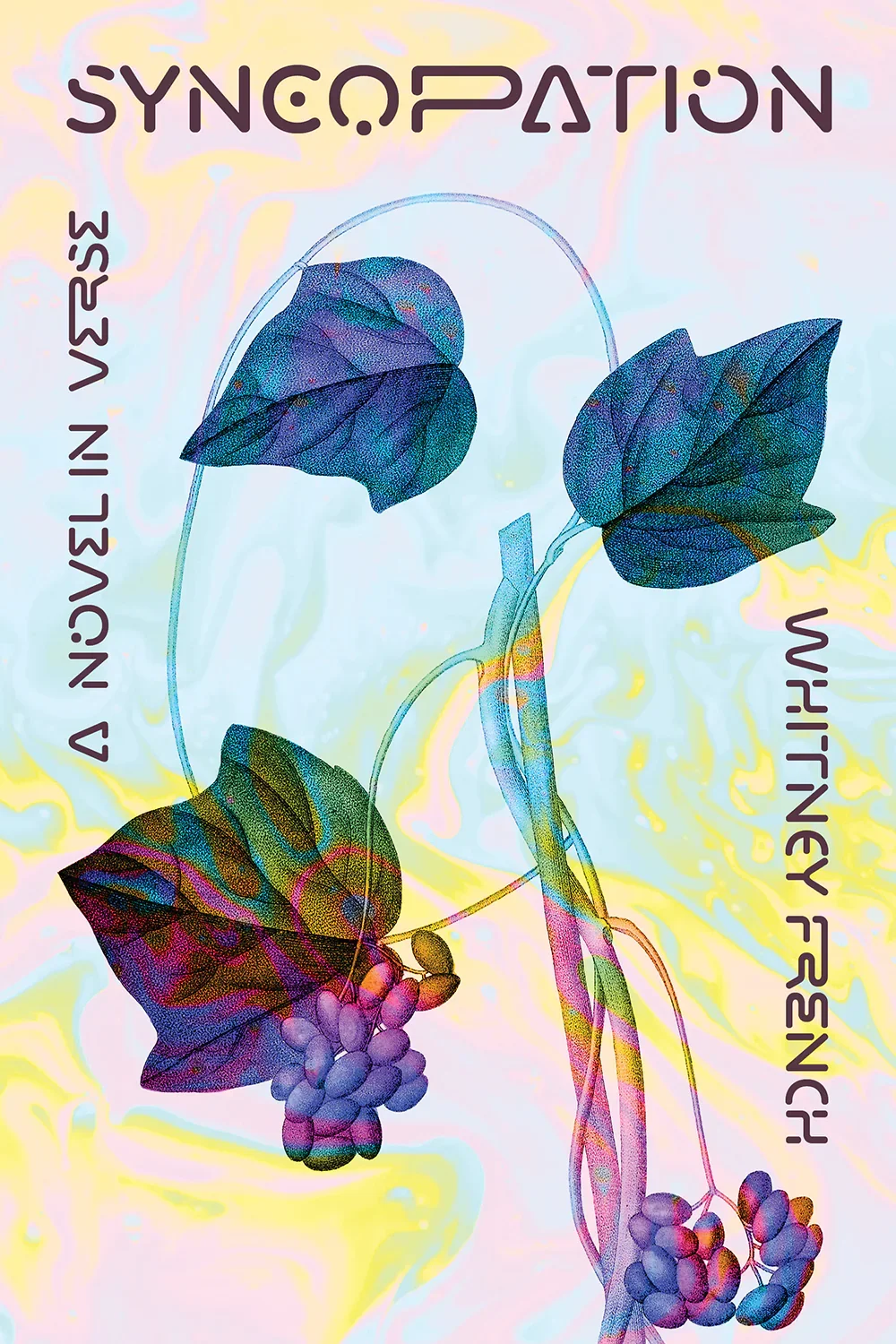
Whitney French’s Syncopation explores what it means to rely on the senses when memory becomes a luxury and a commodity. Throughout this novel in verse, French seamlessly weaves together vivid dystopian world-building, the multiplicity of Black identity, lesbian love and queerness, memory, music, and more. Syncopation is a form-defying narrative that refuses to comply with any traditional notion of linear structure. In the aftermath of what French calls the Memory War, people use chips to replace their memories and sell them, leading to whole identities, names, and stories being forgotten or made obsolete. Since the Memory War, the oppressed classes now rely on the physical senses to build community and tradition—a phenomenon familiar to many who are historical and ongoing victims of colonization. As such, French disrupts any notion of a clear, dominant narrative by relying on rhythm and sound to build momentum and tension.
Fittingly, Syncopation is told in verse. The novel uses a collection of prose poems, “déjà vu suites,” spoken by a collective of nameless characters who both guide and interrupt the love story of O and Z. O and Z’s love story oscillates between their individual perspectives and the perspective of their relationship as a whole. O is descended from “space pirates” and is part of the class of “Neo-Griots,” who store “memory through storytelling, primarily by way of auditory transference” and who “typically have hyper-auditory intelligence & sensitivity.” Z is part of “the Ones who use Earth Technology.” O and Z decide to become travel companions after a chance encounter in a bodega—in a poem aptly named “meet cute”—as they take shelter from the worsening ecological conditions and acid rain caused by industrial mining on the moon. French’s almost scientific description of the act of falling in love—in poems like “menispermum canadense” and “dark biosphere I”—has an ephemeral effect that reverberates through the lines. In the poem, “escape velocity,” for example, she writes of the fundamental forces of nature that cause O and Z’s attraction: “see inertia / see something moving / so fast it escapes the gravity / of its initial starting point.” O and Z’s love escapes its initial starting point, forcing them to reckon with the precarious state of the world and their past personal traumas that directly affect their ability to love, and to accept the love they give each other.
Syncopation is a reflection and refraction; French uses the moon as a finite symbol of intimacy, destruction, and the values that illuminate every action in a dystopian landscape. She creates a world where the profitable alternative to extracting resources from Earth is mining the moon for “moon dust,” since it is considered a source of energy that is “cleaner than fossil fuels.” It is fitting then that the introduction to the world of Syncopation is the poem “moonsong”—an ode to narrative, love, and generational trauma from colonization. “moonsong” foreshadows and provides a thesis for the love story of O and Z: “this land a new lover / this moon an old pattern.” In the latter half of the novel, French dedicates an entire poem to a broader explanation for the mining: “mining the moon (a découpé poem)” is a collage of state propaganda fragments revealing why the working classes and the youth are being sent to mine in space while also providing the backstory of the moon-mining project in the first place. One of the most compelling lines of the poem is its closing, which is only comprised of one word: “cheap”—the ultimate explanation for this exploitation.
Juxtaposing the old and new, French consistently plays with memory as non-linear and triggered only by the senses. Through Z, O learns to see the environment in a different light because of Z’s intimacy and affection for the land, which inevitably rubs off. However, the moon—space, rather—is what is familiar to O; her mother was a pilot, and she plans to follow in her footsteps. O’s mother is introduced in the devastating poem “marauder / mother / Maura,” which provides multiple, contradicting definitions for each word, and sheds light on Maura’s difficult upbringing and the sacrifices she had to make in different phases of her life that led her to being a “space pirate.”
The ending of “moonsong” highlights how every aspect of the narrative is tied to the moon—the tide, “space pirating,” O and Z, and the collective of nameless characters:
on the surface
sea is symbol
never simple, in movement, in relation
in story & moon, from this
view is fated for an elsewhere.
as sun cuts the sky red with day
ocean is longbellied
unaware of Luna’s breaking point.
The last poem, “last déjà vu: new moon,” calls back to “moonsong” with the collective of nameless characters describing how “the ocean is not prepared to catch her lover Luna, the horror of watching a celestial body crumble to ash.” French chooses to describe the moon as a “lover,” symbolizing the ending of O and Z’s relationship. The poem emphasizes how taking away and distorting memory prevents this society from reflecting honestly or wholly, which ultimately becomes a catalyst for anti-colonial resistance.
Musically, syncopation refers to the accenting of a weak or “offbeat” in a song, commonly used in jazz: a music genre originating in Black American culture. Syncopation makes the reader confront these “offbeat” spaces between the dominant notes that structure society: corrupt and exploitative leaders, the erasure of personal and communal histories, and ecological cataclysm. Simultaneously, French highlights the importance of love and connection as a means of survival in such a dystopian, apocalyptic society. This Black, queer, dystopian sci-fi novel in verse is a work of multiplicities, emphasizing the “offbeat,” underrepresented “nameless” characters. In doing so, Syncopation emphasizes the importance of intimacy and connection within revolutionary political movements through the timely, complex love story of O and Z: a love that forces the reader to navigate the tension between our personal and public desires for safety, intimacy, and justice.
PAIGE LEBLANC
is a fourth-year student in Sheridan College’s Creative Writing & Publishing program. They are the current editorial intern at The Ampersand Review and are also poetry editor at the student magazine, B222. Alongside editing, they are an avid reader and writer in various genres and forms.