
Marcia Walker
liz johnston, The fall-down effect
Toronto: book*hug press, 2026. $24.95
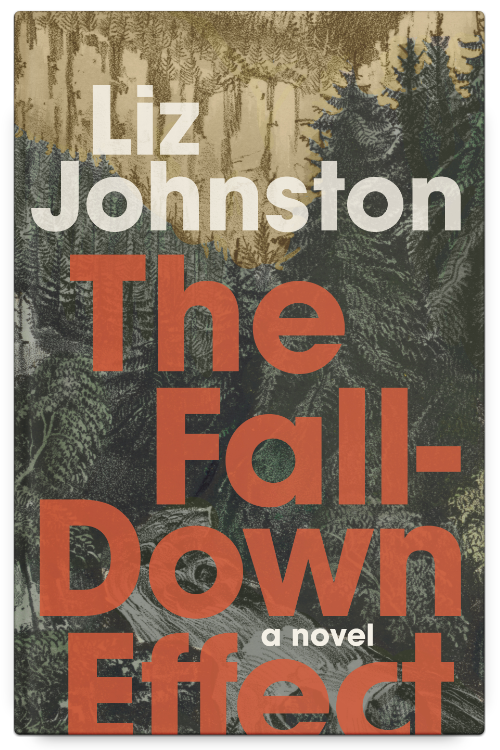
In a time when our world feels more and more fractured and out of control, it’s tempting to reach for simple narratives that comfort, either by distraction or conciliation. The Fall-Down Effect, the debut novel by Liz Johnston, provides no easy solutions to complex environmental questions and difficult family situations, yet it offers something far more enduring: a reminder that no life stands in isolation, whether human, animal, or plant.
Spanning three decades in a small rural town in B.C., The Fall-Down Effect tells the story of Fern, a nature-loving child; her two siblings, Sylvia and River; her father; and her mother, Lynn, a dedicated environmental activist. When Lynn’s roles as a mother and wife begin to conflict with her commitment to the land, she chooses to leave her family and dedicate her life to saving the earth. This creates the first of a series of fallouts which change this family’s ecosystem forever.
The second fallout is when Fern, at age nineteen, follows in her mother’s footsteps and becomes a radical environmentalist. In her effort to make a “big impact,” her protests escalate into a federal offence and she, too, must flee; with no warning or explanation to her parents or siblings, Fern disappears. Regardless, the family protect Fern by keeping her disappearance a secret, but they also silently blame themselves, and one another, for losing her. These recriminations grow, further fracturing the family. Almost twenty years pass and only under the duress of a forest fire do the family reunite to face the hurt and guilt of their shared past.
One of Johnston’s admirable skills as a storyteller is her understanding of how families metabolize regret, blame, and secrets, and how these can compound over years. None of the characters are either wholly blameworthy or entirely blameless. Lynn, the most problematic character, may be vilified by her children at times, but for Johnston such condemnation is too easy. Instead, she lets the reader feel and experience why Lynn believes she must “fight like hell” to protect nature at the expense of her family. As readers, we may shake our heads in judgment, but we are also brought in so close to her that we feel her belief that her “activism [is] enough to make her good.” This moral examination of protest and loyalty, as oppositions, runs throughout the novel.
The Fall-Down Effect asks many questions, and one of its recurring interrogations is what good activism looks like. The novel itself refuses to become a manifesto but instead offers various examples of characters who prioritize ecological preservation by actually labouring in different capacities—in forestry departments, for non-profits, in local grassroots communities, as artists, and as radical activists. And while each figure struggles with different challenges and setbacks, it’s those who continue diligently working in service to the land who emerge from the story most gracefully. What Johnston suggests is that activism must come with humility, otherwise it quickly distorts into egotism and self-importance.
While at one time the term “eco-fiction” may have sounded like the literary equivalent of eating oat bran, writers like Richard Powers and Kyo Maclear have helped to build the genre into an exciting literary experience that prioritizes storytelling and characters that remain with the reader long after finishing the book. Johnston continues this tradition with well-paced scenes and a fluid use of third-person narration. For example, when Lynn literally chains herself (and her three children) to a blockade between the loggers and the forest, the tension is palpable. While her prose remains controlled, Johnston writes deep into the interiority of the characters, slowing the pace to reveal each family member’s emotional reality and reaction to this same event. We feel Fern’s pride, Sylvia’s humiliation, River’s fear, and Lynn’s outrage. The characterization is riveting. At the same time, the overall image of a mother shackling her children in the name of protection is both powerful and deeply unsettling.
The book’s title stems from forestry economics. The “fall-down effect” describes what happens when old-growth forests are harvested faster than younger forests can mature, leading to a steep decline in supply. In Fern’s journal, she reflects on the emptiness of the word “renewable”: “What’s lost is lost. You can’t plant six hundred years. You can’t plant a habitat, an ecosystem.” Johnston uses this ecological concept as both metaphor and warning. Families, like forests, cannot simply regenerate once stripped bare.
And yet, families endure. As Marilynne Robinson writes in Housekeeping, “Families will not be broken. Curse and expel them, send their children wandering, drown them in floods and fires, and old women will make songs of all these sorrows and sit on the porch and sing them on mild evenings.” Despite the distance and hurt within this family, they cannot disconnect. As Sylvia, the responsible and complacent oldest sister, realizes about herself, “she is not a free-floating atom. Her family was a molecule, and she was bound to every member.” Building on Robinson’s adage, this story reminds us that individualism is a seductive and dangerous myth that benefits capitalism more than it reflects our actual experience on this planet.
The Fall-Down Effect is not a conciliatory novel, but it is a compassionate one. It argues that we are bound—to family, to landscape, to history—whether we acknowledge those bonds or not. In recognizing that interdependence, Johnston offers a quiet, hard-won hope: that facing what we have broken is the first step toward living more honestly within the tangled ecosystems of both forest and family.
MARCIA WALKER
’s writing has appeared in Electric Literature, Prairie Fire, Bellevue Literary Review, yolk, The New Quarterly, The New York Times, CBC Radio, and elsewhere. She has been short-listed for the Commonwealth Short Story Prize, PRISM’s fiction and non-fiction prize, and the Writers’ Union of Canada short prose competition. Her debut short story collection, Things to Think About When Looking at the Sky, is forthcoming with Freehand Books in Spring 2027.