
Macie Yott
anna swanson, the garbage poems
kingston: brick books, 2025. $24.99
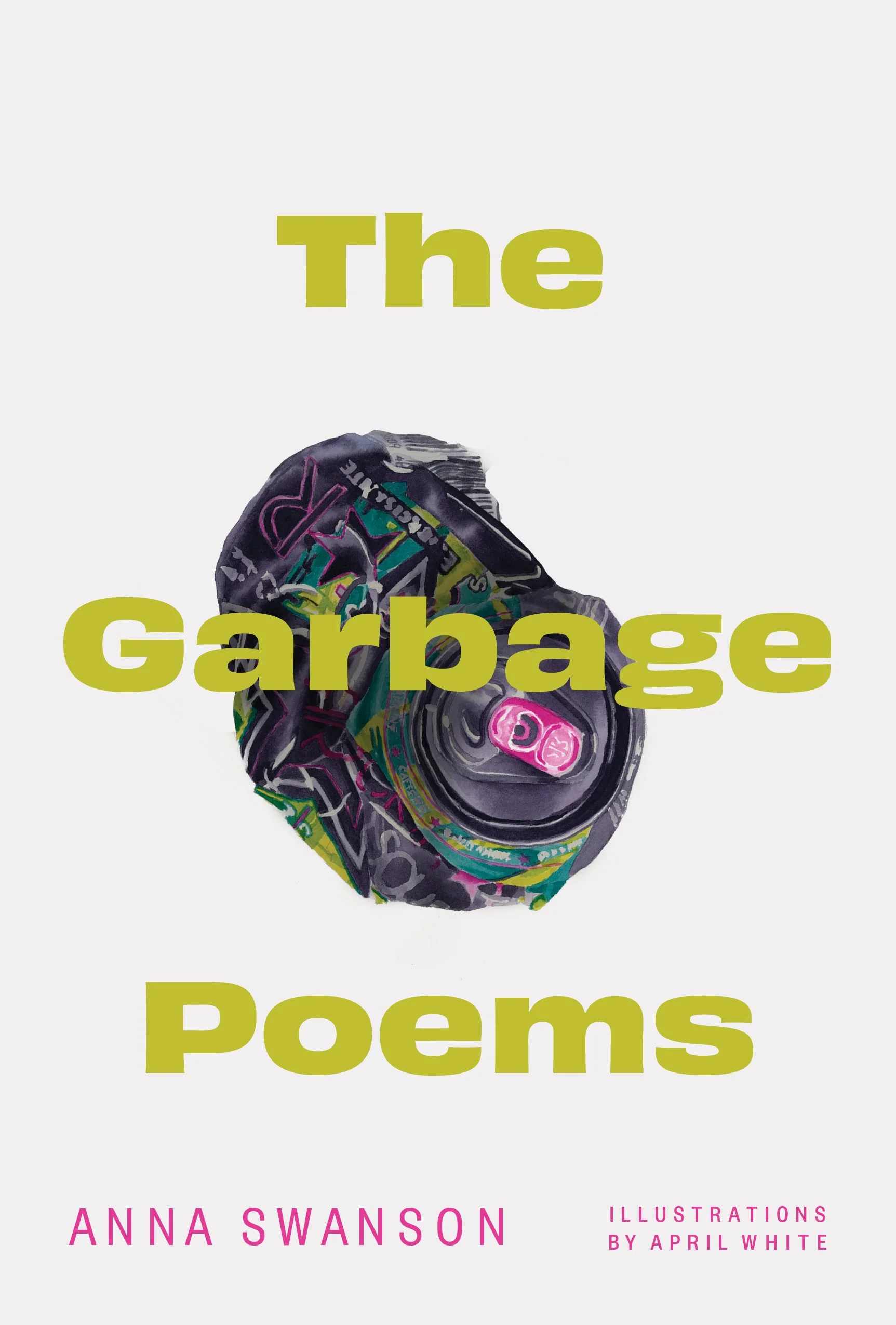
Like a crow’s nest, made up of shiny, recovered fragments, The Garbage Poems is an expansive collection of found material transformed into something luminous. Anna Swanson’s newest book is an inventive reimagining of capitalist vocabulary in which each poem is derived from the text on pieces of litter collected by the author. In a patchwork of queer joy, ecological grief, and reflection on chronic illness, Swanson weaves together the glittering remnants of beer bottles and chip-bag foil into moving poems that surprise and delight again and again.
The Garbage Poems’ inception begins during a writing retreat in Newfoundland, where Swanson collects the garbage left in and around the natural swimming holes on a near daily basis. As her attention turns not only to the quantity of litter she collects but the text and labels on each item, she begins to develop a process and structure for the collection, which she defines as the project’s “constraint, n.”:
I rearrange the words to create small proto-
poems about the swimming hole. I can re-use
words and combine them, but never shorten
or split. If a word is torn, or partly worn off,
I transcribe whatever fragment remains …
Every other word of a poem must be found
or made by combining.
The resulting collection is divided into six sections, each named after the swimming holes whose litter make up Swanson’s corresponding poems: Flatrock, Punch Bowl, Big Punch Bowl, Roblin Lake, Cape Broyle, and Beachy Cove. Interspersed between these sections are Swanson’s personal lexica, which give meaningful insights into her creative process. As she revisits her vocabulary, the poet subverts traditional etymological definitions, layering them with fragments of emotion or memory in order to reclaim their poetic power. It is within these upcycled definitions that Swanson also includes intimate vignettes recalling feelings of both hope and frustration as an individual living with chronic illness. The poet emphasizes that healing is a nonlinear journey, narrating years of gradual recovery followed by renewed perseverance in the wake of, in the speaker’s case, a serious concussion. Time and time again, Swanson returns to the swimming holes, highlighting their role as temporary but treasured sanctuaries. In the water’s reprieve, the body becomes more than its symptoms or labels, wholly conscious and present. For the poet, cold-water swimming is, at its centre, “[n]ot a remedy, not a biohack or productivity strategy, but a letting go of fixes and cures.”
Most impressive about this collection is Swanson’s ability to take the language of discarded inanimate objects and transform it into something deeply human and alive. Her poetics here capture countless brilliant, fleeting moments, leaving readers feeling as though they too have dived into those ice-cold waters and completely submerged their senses. The poem “Blessing for the Swim Selfie,” for example, is an indulgent medley of textures, flavours, and hues that also serves as an invitation to the reader:
Layer by layer, let us onion
open into the sun. Let us swing,
pantsless as tolling bells,
into the green-gold water.
The Garbage Poems includes playful cameos from its source material, with some corporate brand names written outright. In “Gesture Goods,” for example, Swanson identifies one of the many companies whose single-use products continue to accumulate in the wilderness: “Praise the tossing back, the open throat cooled / by a can of Palm Bay Strawberry Pineapple Vodka Spritz.” In other poems, like “Portals,” the original marketing text from the packaging has been stripped down much further, uncovering the lyrical beauty hidden within warning labels or advertisements:
Now I dive toward the perfect
doorway of my outline,
the rippling of a beaded curtain
about to part.
While there is a clear brightness within Swanson’s writing, The Garbage Poems is inseparable from a larger sense of ecological grief. There is an openness in the poet’s voice as she shares feelings of climate anxiety and encourages us to ask questions, to hold corporations accountable, and to imagine a landscape unencumbered by single-use waste. But in the same breath, Swanson also reminds us that her writing is not only ecological. At the heart of many poems in this collection is an all-encompassing celebration of queerness and sexuality. The Garbage Poems tells us about “bottle laws” and “gesture goods,” but it also explores the meanings of “cure narrative,” “autonomic conflict,” and “survival joy.” Garbage becomes “found text,” and litter is replaced with “love.” Trash becomes memorabilia, and language becomes poetry, as Swanson recounts sunlit undressings and night swims where, along with her readers: “[w]e are a queer candy / in the underwater light.” In a landscape marked by discarded fragments, the poet brings us soft moments of connection that assert to fellow queer readers: Our ways of loving endure.
A review of The Garbage Poems would not be complete without touching on its gorgeous watercolour illustrations by April Mary Lynn White, an award-winning Canadian artist from the East Coast. Seeing the richly coloured renditions of the real-life litter next to the finished poems—interactively designed for the web by Matthew Hollett and available at garbagepoems.com—truly highlights Swanson’s inventive recycling and reclamation of capitalistic language. Under the poet’s thoughtful direction, the mundane is transformed into the magical, and the commercial is transformed into the intimately human. In this way and others, The Garbage Poems is an innovative, heartfelt collection that reminds us of the creative potential hidden within our material world. With raw, playful diction, and warm authenticity, Swanson immerses readers into a pool of lyrical language where every current of grief is met by the indelible demand for joy.
macie yott
(they/she) is fourth-year student in Sheridan’s Creative Writing and Publishing program. A queer writer of Chinese and Canadian descent, they have worked as an editor at the student-led B222 Journal and are currently an events & communications intern at The Ampersand Review.