
Kevin MacDonald
Shane neilson, What to feel, how to feel: lyric essays on neurodivergence & neurofatherhood
windsor: palimpsest press, 2025. $21.95
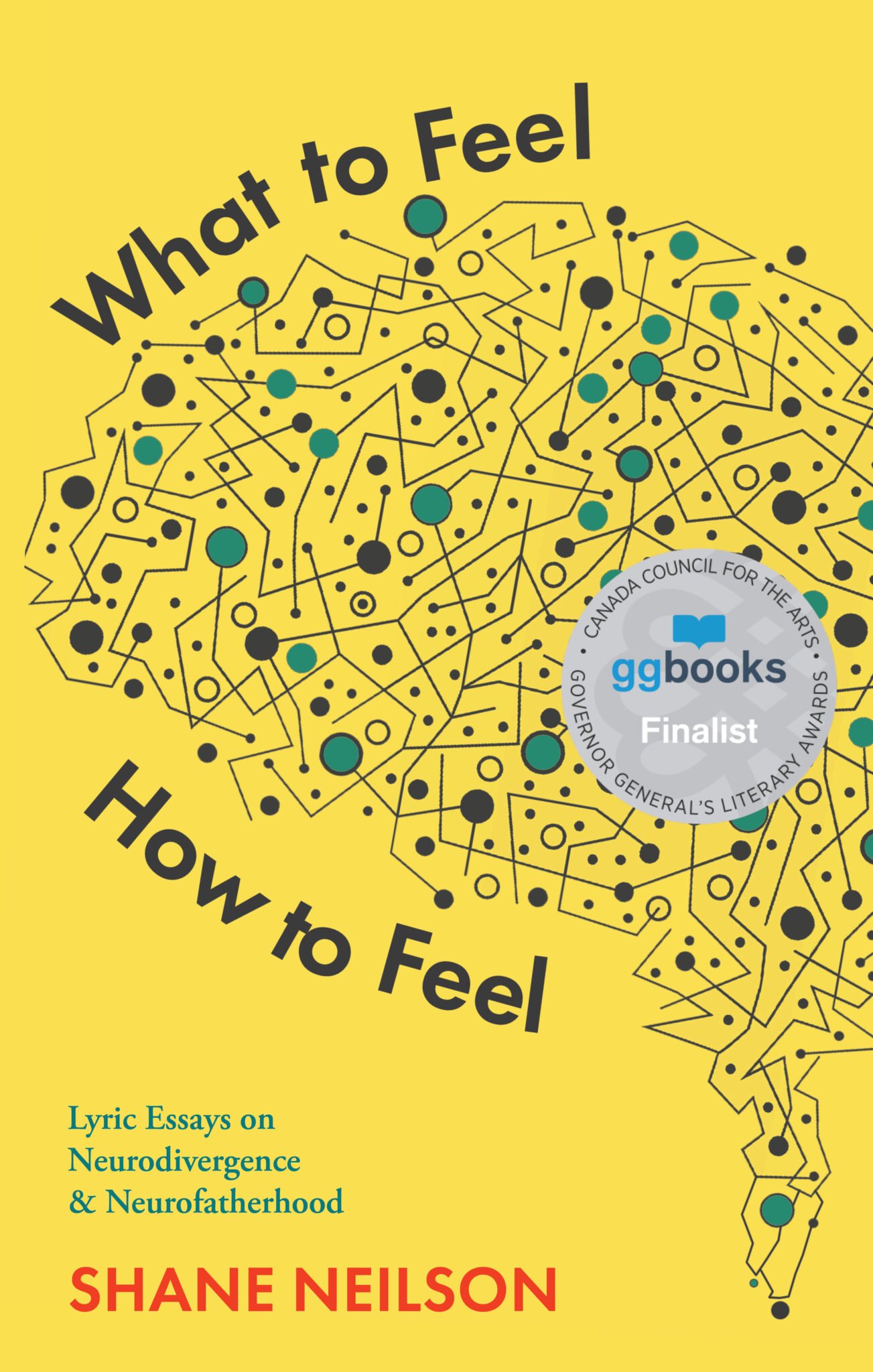
“Shame is the foundation on which all oppression operates,” writes Shane Neilson, an autistic poet, physician, and author of What to Feel, How to Feel—a worthy finalist for the 2025 Governor General’s Literary Award for Non-fiction. Neilson’s collection scrutinizes the intergenerational impact of shame and social stigma on people living with disabilities. But it also functions as a confessional family history and a blistering social critique condemning overt and covert violence against the disabled in an ableist society. Ranging from unbridled fury to eye-watering vulnerability, Neilson’s evocative voice exposes the hidden struggles individuals with disabilities confront every day. He shines a light on society’s mistreatment of those who are different and exhorts us to construct a more compassionate and accepting world for non-normative people.
The essay “On Stigma,” (first published in Issue 6 of The Ampersand Review of Writing & Publishing,) begins with Neilson scattering his father’s ashes into the Wolastoq River in New Brunswick. Neilson recounts vivid episodes of experiencing and enduring physical and emotional abuse perpetrated by his father, remembering “the altered gait of his inebriated approach . . . [conjuring] a feeling that doubles as an imperative, a saving fear that is also an action: Run.” Years later, after his father’s death, Neilson wonders, “can righteous pain be released by turning injury into an opportunity to understand?” In this hope he unearths an untold story about his father, learning that he was once taken to a psychiatrist to have his own “abnormal behaviour” examined in an institution for the “mentally defective.” His father, he comes to understand, was a victim of bullying, as Neilson hears for the first time of the instance when several men shoved his father into a barrel and rolled him down hills just to entertain themselves. “On Stigma” allows Neilson to navigate anger and grief while finding ways to empathize with his father, leading him to question the extent to which shame catalyzed his own abuse and was “as destructive for my father as it was to me.”
Section 2 tracks Neilson’s sense of difference and otherness, from his childhood all the way through to his ongoing medical career. The section begins with “Diagnosis Day,” an essay probing the trauma he suffered while growing up “different,” and the catharsis of receiving an autism diagnosis as an adult. In “Spoon Under the Table,” he rails against the dichotomy of so-called visible and invisible disabilities, arguing that his own “difference” has always been visible and constant, following him through medical school and into his professional practice. In “Two-Hit Hypothesis,” he examines how the medical profession’s culture of rampant perfectionism and the unrelenting demands it places on its practitioners result in discrimination against disabled medical professionals. Specifically, we see how such discrimination contributed to his own sense of alienation within the profession, reinforcing the idea that there was something fundamentally “bad” about him. In “Blurring the Borderline,” Neilson confronts this “badness,” bravely documenting his recovery from a suicide attempt. He learns, eventually, to tell himself he isn’t bad; “the tragedy is that you are good, but you cannot see the fact, you cannot let yourself see it.” Neilson continues to explore the wounded healer archetype in “Chiron the Wounded Healer,” tracing the figure’s roots in Greek mythology through the work of Dr. Károly Kerényi, the academic who inspired Carl Jung’s conception of the archetype. Tellingly, Neilson’s dedication to healing others inevitably helps heal his own wounds.
Section 3, “Neurofathering,” offers an intimate glimpse into Neilson’s experiences raising his intellectually disabled son, Kaz. In “Like Father, Like Son,” he chooses his words carefully, writing: “Only the parents of other intellectually disabled people can understand this burden. Yes, fuck you, burden.” He grieves for his son’s losses, confessing, “I still occasionally fantasize about normativity, the doomed dream he might turn into a normal boy and have the normal things taken for granted by us.” In “McDonaldsing into the Future Death,” he introduces the reader to Frink, a part-Nestea, part-Fruitopia concoction that Kaz considers “the meaning of life; Frink as the purest joy.” But as Kaz savours Frink, Neilson can’t help but wonder who will be around to love his son and take him to McDonald’s for Frink once he’s dead. These essays teem with love and fear, and our hearts cannot help but ache for Kaz and his father as we consider their inevitable trajectory.
The spectre of Neilson’s father, Doug, haunts him from beyond the grave throughout the essays in this collection, and the imperative which protected him as a child—“Run”—manifests in the text whenever Neilson’s memories become too painful. He alternates between reliving traumatic private memories and examining public though sometimes obscure intellectual history, using narrative distance and a command of writerly craft to create a safe space for reflection. Sometimes it’s an imaginary conversation with Erving Goffman in a diner, interrogating the great sociologist’s dramaturgical theory and how it relates to Neilson’s struggles passing as “normal.” Other times he’s poring over the diaries of an unknown American poet named David Ignatow to reflect upon his own fathering. Close readers will recognize that Neilson’s oscillating, recursive shifts in scope mimic the patterns of confrontation and avoidance that characterized his survival adaptations as a child. But it’s his dazzling erudition and tender, furious heart that will invariably compel his readers’ empathy and attention throughout these essays. Whether you’re seeking luminous language and experimental forms, a brilliant polemic, or a life-affirming meditation by a loving father and doctor, What to Feel, How to Feel is a singular, highly original disability treatise that establishes a new frontier for medical narratives in Canadian literature.
Kevin macdonald
is an Edmonton-based communications professional who holds an HBA in Creative Writing & Publishing from the Sheridan College Institute of Technology and Advanced Learning. His writing has been featured in Flash Fiction Magazine, Savant-Garde, and The Ampersand Review of Writing and Publishing. When he isn’t reading or writing, you can find him exploring new restaurants and spending time with friends and family.