
Filomena Cozzolino
sam cheuk, black milk tea.
Toronto: Anstruther Press, 2025. $10.00
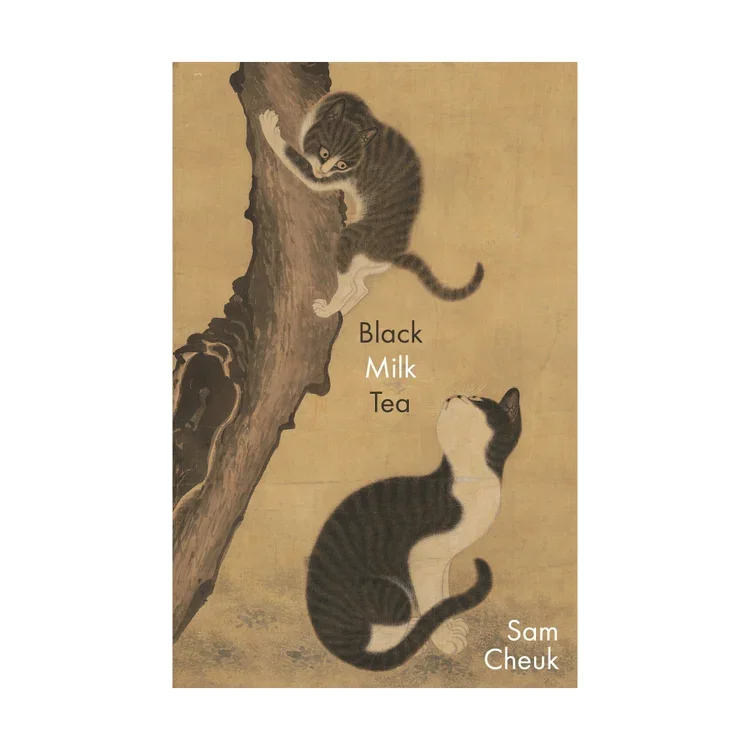
In his recent poetry chapbook, Black Milk Tea, Sam Cheuk delicately unpacks the frustrations that immigrants must either bury or learn to endure as they emigrate. Cheuk gives readers a poetic glimpse into the experience of those coping with, confused by, or conflicted about the barriers that must be breached when moving between cultures. These poems explore the collision of assimilation with the desire to grasp and hold onto cultural roots that suddenly seem to be slipping away.
Black Milk Tea is held together by a diasporic motif. Cheuk dips into the minds and perspectives of middle-aged men, mothers building better lives for their children, and travellers searching for a common language; his speakers share a glimpse of their griefs, joys, and aspirations. While the speaker of “Hoi Polloi” visits France, they feel incapable of communicating at all, failing to speak French in the same moment the grocery store clerk is failing to speak English. The clerk takes a chance and speaks Cantonese, and a wave of relief engulfs them both as they suddenly “knew one another / in a language [they] refuse to forget.” Cheuk captures how individuals feel when trying to exist in a world where cultures and languages—from their home country, their new home, or the country they are visiting—seem to “emulsify.”
Yet, no two speakers view their diaspora or identity the same way. The speaker in “Absolution” feels the need to absolve themselves of the “sins” of their complicated feelings of belonging and cultural ritual. Throughout the dozen poems here, Cheuk expertly depicts the various ways individuals deal with feeling like the “other,” quell anxiety by speaking to those in their shared diasporic community, and unpack manifestations of lingering shame.
The poem “Black Milk” demonstrates the aspirations immigrant parents hold for their children. The speaker describes her child as one “who ticks on the metronome like a miracle like / crests of sand dunes forever waving hereafter and after.” Her child’s future is ever-changing, malleable, adaptable, and, like sand, she hopes they will be able to slip into the spaces and cultures around them with ease. The speaker also uses repetition to communicate with readers. Cheuk begins nearly every line with “My child,” to convey the speaker's growing anxiety as she watches the child grow while learning a new culture alongside her. The repetition fades when her child passes away, as if she is losing her means of communication altogether.
In Black Milk Tea, Cheuk beautifully explores how individuals struggle to embrace their identity and heritage as they change. This chapbook is a fervent, poignant reminder that, alone as we may feel between cultures, there is always a community of other “others” in whom we can confide and find shared experience.
FILOMENA COZZOLINO
is a reader and writer studying in Sheridan’s Honours Bachelor of Creative Writing & Publishing program. Although introverted, she connects with the literary community by volunteering at events such as The Word on the Street and The & Festival. Her coffin-shaped bookcase is filled with ghost stories, romance, poetry, and more. In her downtime, she can be found reading in the park or wandering wooded trails.